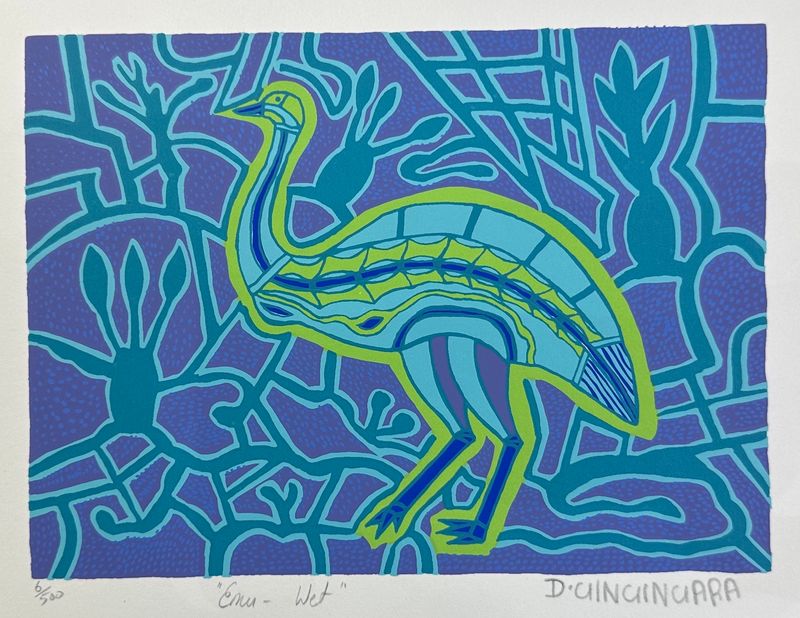
Doris Gingingara
Doris Gingingara(1946–1999) was born at Maningrida, an Aboriginal community in Arnhem Land, Northern Territory. She grew up living a traditional life, learning the skills and responsibilities of women of the Barada clan.
As a child, Doris spoke of being taken by Mimi spirits and placed high in a tree, where she was taught basket weaving and net making. Mimi are powerful ancestral beings in Arnhem Land culture, often depicted as elongated, delicate human figures in bark painting traditions, and are known as teachers and custodians of knowledge.
Her art draws deeply from these early experiences—everyday life in the bush, Dreaming totems, sacred sites, and the ceremonial traditions of her people. Doris also responded to the landscapes around Mt Magnet, the remote Western Australian mining town where she later lived until her death. Together, these influences shaped a body of work that conveys the world through an Aboriginal woman’s perspective, exploring the intimate and layered relationship between people, place, and the natural environment.
Gingingara’s compositions are distinguished by their intricate patterning and luminous colour. She worked with rich ochres—warm pinks and yellows, burnt reds and deep browns—often heightened by vivid blues, greens, and purples. The result is a striking harmony of colour and detail, alive with rhythm and movement.
Doris Gingingara’s work has been described as one of the most exciting developments in contemporary Australian art, seamlessly blending traditional Aboriginal culture with innovative materials and modern expression.
Collections include:
Artbank, Sydney
National Gallery of Australia, Canberra
Art Gallery of Western Australia, Perth
Flinders University Art Museum, Adelaide