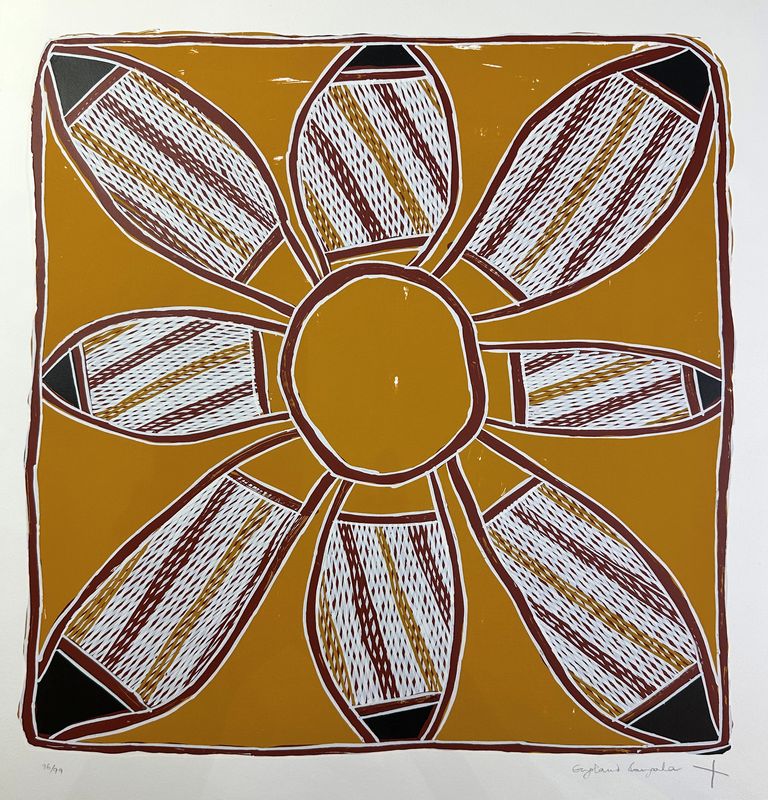
England Bangala
England Bangala (c.1925–2001) was a fully initiated An-nguliny elder from the Cadell River region of south-central Arnhem Land. A respected custodian of Gun-nartpa language and ceremony, he recorded the sacred history and ancestral religion of his Country through bark painting, paper works and carvings.
Emerging in the mid-1970s alongside leading Maningrida artists such as John Mawurndjul and Johnny Bulunbulun , Banggala helped transform ancient rock and ceremonial designs into a contemporary professional practice through the Maningrida Arts & Culture.
His paintings depict interconnected sacred sites including Djijapuny (ancestral water serpents), Jingabardabiya (female water spirits), Boplinymarr and Lorrkon Djang (hollow log coffin Dreaming). These works function as visual maps of a spiritually created landscape inhabited by totemic beings such as barramundi, mullet, water lily, long-necked turtle and crocodile.
Bangala’s style is distinguished by bold linework, strong symmetry and controlled rarrk (cross-hatching), often concentrated on the torso in reference to ceremonial body painting. Large colour fields and rhythmic compositions reflect the water and stone country of south-western Arnhem Land and his connections to Rembarrnga tradition.
Primarily working on bark, he later painted on Arches paper at Injalak Arts and Crafts. A senior ceremonial leader who had passed full Burrara/Gunardba initiation, Banggala possessed deep esoteric knowledge and officiated across central and western Arnhem Land.
His work is held in major Australian and international collections and featured in landmark exhibitions including Art of Aboriginal Australia (Canada, 1974–76), A Myriad of Dreaming (1989), the Adelaide Biennial of Australian Art , and Aratjara: Art of the First Australians (1993–94). His distinctive style is considered unique within Arnhem Land art history.