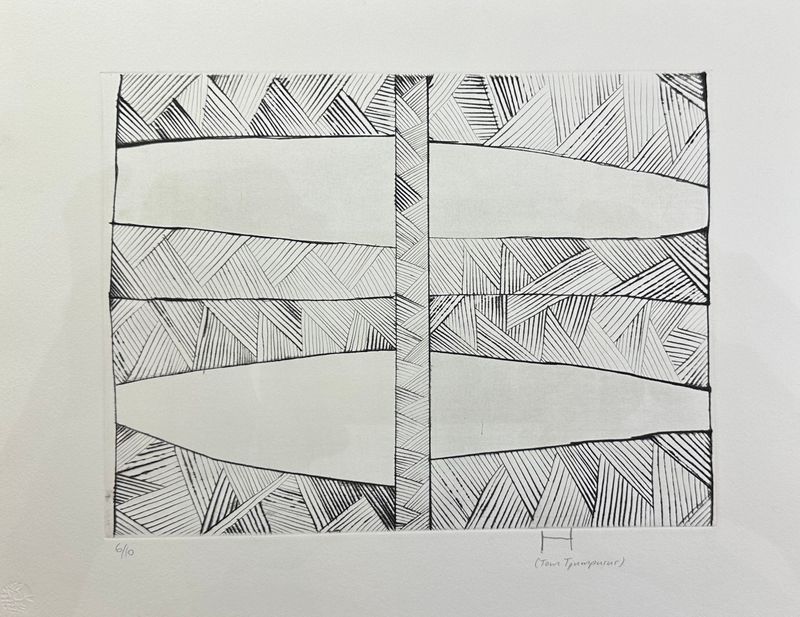
Tommy Tjumpurur
Tom Djumburpur was born in the bush on his ancestral country at Djilpin, south-west of Ramingining, near the upper reaches of the Goyder River. Following the deaths of his parents in the early 1930s, he was raised by an uncle and continued to live a traditional life away from the mission. He was initiated at Murrwangi and learned to paint from his second father, Charlie Wagirr.
Djumburpur’s first exhibition was held in Melbourne in 1983—his first visit to the city—where several works were acquired by the then Minister for Aboriginal Affairs, Clyde Holding. Further exhibitions followed in Brisbane and Adelaide in 1987. In 1988, he contributed bone coffins to the landmark Aboriginal Memorial at the Biennale of Sydney, now permanently installed at the National Gallery of Australia.
He worked in two distinct styles: refined, minimalist bark paintings using ceremonial body designs to depict the Wagilag Sisters Creation Story, and powerful figurative works featuring monumental ancestral beings. His signature is the use of silver-white clay applied in strong, graceful strokes, often set against rarrk (cross-hatching), geometric forms, sacred rocks and waterhole motifs. Many of his barks are shield-shaped.
In 1997 Djumburpur participated in the Ramingining Print Suite workshops led by Theo Tremblay, producing an important collaborative body of prints based on the Wagilag Sisters story. His works are held in major Australian and international collections.