
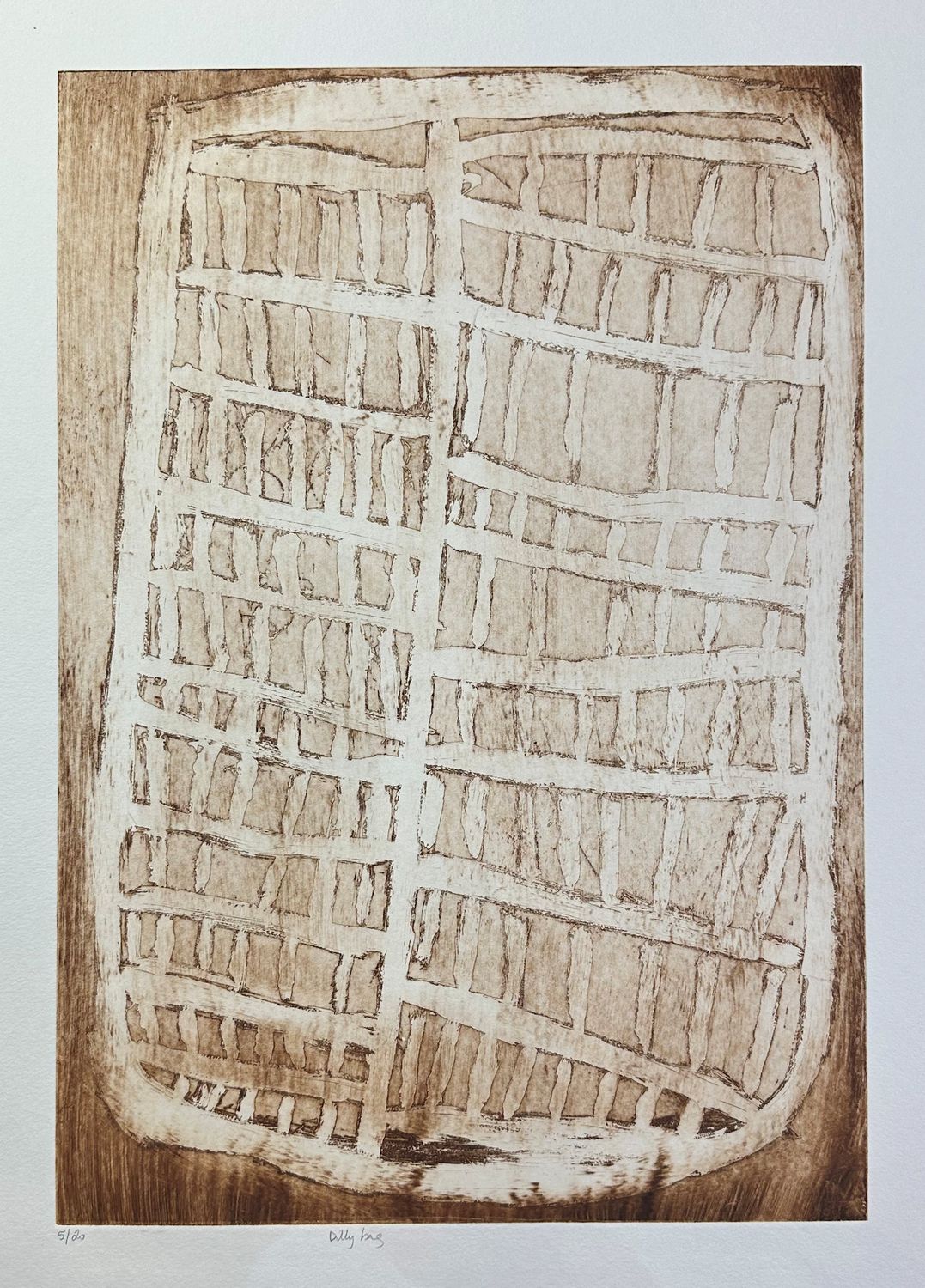
Susan Marawarr, Dilly Bag, Etching, Maningrida, 5/20
Susan Marawarr, Dilly Bag, Etching, Maningrida, 5/20 Paper: 65x50cm Image 49x35cm
From the MCA Handbook: Susan Marawarr belongs to the second generation of Kuninjku artists who emerged at Maningrida in Central Arnhem Land in the late 1990s. In 1972, after a decade living in Maningrida, her family re-occupied Mumeka as an outstation where her father, Anchor Kulunba (circa 1917–1996), was sole custodian and user of the distinctive mandjabu fish trap that appears in her later prints. Marawarr learnt to make a variety of traditional fibre items during this time under instruction from her talented mother Mary Wurdjedje and second mother Mary Marabamba, including semi-rigid twined baskets, looped string bags and coiled baskets with colorful dyed patterns.
After Kulunba’s death Marawarr began to branch out as an artist. This was a time of considerable change, with many Kuninjku women deciding to paint, including Marawarr’s brother John Mawurndjul’s wife Kay Lindjuwanga and their daughters Anna, Semeria and Josephine Wurrkidj, and her brother Jimmy Njiminjuma’s daughters Irenie Naglinba and Aileena Lamanga. By the late 1990s Mawurndjul’s work was also changing, moving away from conventional figurative painting to his masterful all-over rarrk (cross-hatching), Mardayin-inspired imagery, which considerably influenced Marawarr and other artists. These include her recent series of barks and hollow logs about the Mardayin Wak Wak (Crow) at Kurrurldul south of Mumeka.
Marawarr is a highly versatile artist with a unique minimalist painting style evident in her bark paintings, lorrkon hollow logs and Mimih, Buluwana and Dajurru carved figures. Her other passion is printmaking (including etching, lithography and screenprinting) and fabric printing, often inspired by customary fibre forms. Her debut as a printmaker in 1999 is best remembered in the 2001–2003 exhibition Bush Colour: Works on Paper by Female Artists from the Maningrida Region , which was one of a number of creative partnerships between the Maningrida’s Babbarra Women’s Centre and the Northern Editions print studio at Charles Darwin University in Darwin. The exhibition toured the United States of America, during which time Marawarr ran bark-painting workshops at the Kluge Ruhe Aboriginal Art Collection at the University of Virginia.
Marawarr’s print Red mat (2001) captures both her familiarity of family-owned forms and her unique ability for formal abstraction, highlighting the inherent fragility of the depicted object with an economy of line work. Red mat was later featured in the MCA’s 2003 exhibition Maningrida Threads: Aboriginal Art from the MCA Collection . Images of fibre items recur in Marawarr’s prints, alongside significant ancestral themes also depicted by the male artists in her family, including Ngalyod the Rainbow Serpent and yawkyawk mermaid spirits. In 2000, because of her knowledge of fibre, Marawarr assisted Waanyi artist Judy Watson with her installation ngarrn-gi land/law of steel fish-traps and bronze dilly bags in the Walama Forecourt at Sydney International Airport.
Marawarr continues to work for Maningrida Arts & Culture and the Babbarra Women’s Centre where she produces a range of items that reflect her emotional connection to women’s fibre and the ancestral beings and stories that belong to her Kurulk clan